
Return to journal
Your corporate website has a new job
Francesca Bennett explores why the corporate website is shifting from destination to source, and what that means for how organisations manage their story
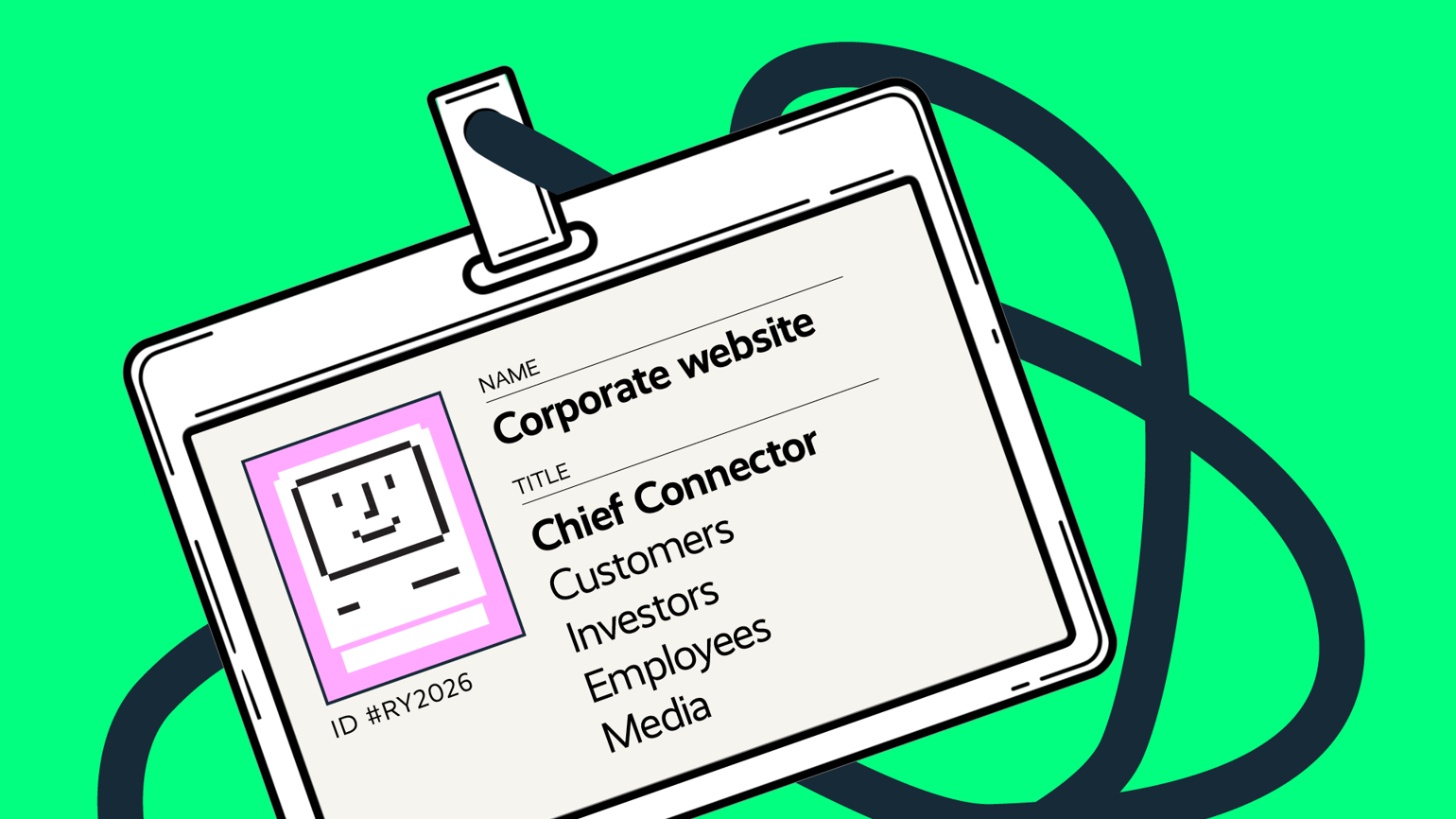
For years, we've thought about corporate websites in broadly the same way. They're a channel. An important one, certainly, but one that sits alongside many others. Somewhere your audiences come to find information, understand your business, explore your products or services and perhaps decide whether they want to work with you, invest in you or work for you. It’s interesting to consider whether that description still fits or whether their role is quietly changing beneath our feet. It’s also worth thinking about whether we’ve all truly grasped what this means for our corporate communications.
The conversation over the past eighteen months has understandably focused on AI. How people search is changing. Traffic patterns are changing. Discovery is changing. Those are all important conversations, but is it possible that they've distracted us from the more interesting shift that's taking place underneath? The corporate website is no longer simply where people go to understand an organisation. It's increasingly becoming where everyone else learns how to explain it. That might sound like a subtle distinction, but I think it changes a great deal.
For years, the challenge was attracting someone to your website. Today, many of your stakeholders arrive having already formed an impression. They've read an AI-generated summary, seen a search overview, asked a colleague, read a review, or been introduced to your organisation through any number of intermediaries before they've ever landed on your homepage. Your website is no longer making the first impression as often as it once did. Instead, it's being asked to validate, reinforce or occasionally correct one that's already been formed. Which means the role of the website has shifted from destination to source. That's an important change because these new intermediaries don't invent information. They assemble it. They interpret what they can find across your digital estate, combine it with other trusted sources and produce an answer that someone else relies on. Sometimes that answer is excellent. Sometimes it's incomplete. Occasionally it's simply wrong. But whichever it is, it is increasingly shaping how your organisation is understood.
The uncomfortable question, then, isn't whether AI is talking about your business. It almost certainly is. The more interesting question is whether it's learning from the right places. Historically, organisations have managed their digital estate in much the same way as they manage themselves. Marketing owns one part. Corporate Affairs owns another. Investor Relations publishes reporting. Sustainability manages ESG content. HR looks after careers. Digital provides the platform. Legal provides the guardrails. All entirely logical. The only problem is that AI doesn't see departments. It simply sees one organisation. It doesn't distinguish between your beautifully crafted strategy page and a forgotten PDF from five years ago. It doesn't know which team owns which message or whether one section of the site has been refreshed while another has quietly drifted out of date. It simply assembles the evidence it finds and presents it back as a coherent story. Whether that story is coherent in reality is, of course, another matter.
That's why I think the conversation about corporate websites needs to move on. We've spent years discussing channels, content and user journeys, when perhaps we should now be talking more about organisational truth. Not truth in the philosophical sense, but in the practical one - a narrative truth. Is there a clear, consistent and credible version of your organisation that exists across your digital estate? If someone or something tried to explain your business using only the information you've published, would they tell the story you want them to tell?
What's particularly interesting is that this doesn't reduce the importance of brand. If anything, it elevates it. As structured information becomes easier to generate, summarise and compare, the things that remain difficult to replicate are the things that have always made organisations distinctive: a clear point of view, an authentic tone of voice, thoughtful explanation, compelling evidence and a personality that runs consistently through everything they publish. What makes the organisation ‘feel’ true to itself? How is this expressed digitally?
The temptation, of course, will be to optimise everything for machines. Cleaner structures. More consistent headings. Better metadata. More schema. All of that matters. But if every organisation follows exactly the same formula, we'll end up with technically excellent websites that are almost impossible to remember. The winners won't be the organisations that choose between creativity and clarity. They'll be the ones that understand they now need both, often in equal measure.
Perhaps the biggest implication, though, isn't creative or technical, but rather organisational. If your website is becoming the source material from which your organisation is increasingly understood, then it can no longer be treated as a marketing asset, or a digital platform, or a reporting repository. It becomes shared infrastructure. Something that requires governance, collaboration and collective ownership because every function contributes to the picture that external audiences and increasingly intelligent systems build of your organisation. And that feels like a very different job indeed.